





Product Overview

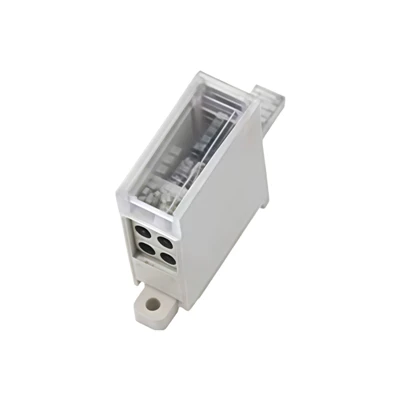
The Switch Terminal 400 Frame 6x16 is a direct-connect extension terminal that spreads the load side of one 400 A frame moulded case circuit breaker across six independent branch circuits, each accepting up to 16 mm² copper.
Splitting six ways off a 400 A breaker the conventional way takes a busbar and six separate terminal joints between the breaker and its loads, and every one of those intermediate joints is a point to torque, inspect and re-tighten for the life of the panel. This block leaves them out: the six outlets are one body that lands plug-on on the breaker's load terminals, leaving only the six clamps that carry current.
Technical Specifications
Electrical rows are this model's published figures; commercial rows at the foot of the table are range-wide reference values.
| Item | Specification |
|---|---|
| Function | Direct-connect extension terminal spreading one 400 A frame MCCB load side into six branch circuits |
| Frame Rating | 400 A continuous duty, matching the breaker the block is fitted to |
| Outlets | 6 output circuits on one body |
| Wire Range | 2.5–16 mm² solid and stranded copper per outlet |
| Current Per Outlet* | 63 A with 16 mm² copper |
| Conductor Material | High-conductivity copper alloy with 5 µm tin plating |
| Insulation | Flame-retardant engineering plastic, UL94 V-0 |
| Tightening Torque | 1.2–1.5 N·m |
| Mounting | Plug-on to the breaker's load terminals; screw-fixed to the panel |
| Brand Fit | Dimensioned to standard 400-frame MCCB terminal patterns; send the breaker model and the fit is confirmed against the terminal drawing |
| Customization | Outlet count, pitch and hole pattern produced to drawing; OEM and ODM available |
| MOQ* | 10 pieces |
| Lead Time* | 7 to 10 days standard; 15 to 20 days custom |
| Quality Guarantee* | 12 to 24 months, counted from the shipment date |
| Manufacturing Standard* | ISO 9001 quality management system |
| Delivery Ports* | Ningbo Port / Shanghai Port |
| Quote Turnaround* | Within 24 hours of receiving the enquiry |
* Rows marked with an asterisk are series reference figures shared across this breaker terminal range. Model-specific datasheets and test reports are available on request.
Core Advantages
Four reasons panel integrators standardise on a direct-connect block in place of a busbar assembly.
Six Circuits From One Body
The six outlets are part of the block itself, not an assembly of busbar, links and individual terminals bolted up on the bench, so what arrives is what gets installed.
No Intermediate Joints In The Load Path
Current runs breaker to block to branch conductor, and nothing stands in between except the clamp that carries it. Fewer joints means fewer loose-connection failures to chase.
Less Bench Work Per Panel
No busbar has to be cut, drilled, insulated and mounted before the first conductor lands, so assembly is shorter and troubleshooting is a one-row job.
A Torque Band On Record
The published 1.2–1.5 N·m band gives fixtures and maintenance rounds one number to work to, and thermographic inspections a baseline to compare against.
Direct 6-Outlet Extension Block vs Busbar With Intermediate Joints
The comparison that settles this purchase is joint count, because joint count is what ages in service.
| What Changes | This Direct-Connect Block | Busbar With Separate Terminals |
|---|---|---|
| Joints per six circuits | Six clamp points in total | Bolted busbar joints plus six terminal joints |
| Load path | Breaker to branch with nothing added in between | Every branch crosses a busbar joint first |
| Points to inspect | One row of six screws | Busbar bolted joints and terminal screws together |
| Panel space | One compact block | Busbar length plus a full terminal row |
| Assembly work | One unit, ordered and installed as one | Bar cut, drilled, insulated and mounted on the bench |
| Torque record | Published band of 1.2–1.5 N·m | Set joint by joint, whatever the fitter uses |
Professional Production Process
Six steps, each signed off against a measured check.
1.Each copper alloy coil is checked on receipt for conductivity grade and plating thickness before it is released to the line.
2.The conductor strip is cut and formed into the six-outlet pattern, its pitch gauged against the 400-frame drawing.
3.Contact faces are dressed flat, so a 16 mm² conductor seats over its whole face rather than on a burr.
4.The formed conductors are set into the housing, and seating depth and outlet alignment are verified.
5.Every unit passes a continuity and clamping check at the published torque, logged by batch number.
6.Insulation and overall dimension are re-verified before the cartons are sealed.
Material & Surface Treatment Options
Two material decisions carry the block, and both are cheapest to settle before tooling.
Tin-Plated Copper Alloy Conductor
Five microns of tin over the high-conductivity copper alloy keeps the contact faces free of the oxide film that raises joint resistance in damp boards and seaside installations.
Flame-Retardant Housing, UL94 V-0
The engineering-plastic housing locates all six outlets and carries the insulation duty next to a 400 A breaker compartment. A different compound or a higher documented rating is a choice to make at the drawing stage, not at goods-in.
Application Scenarios
Where six feeds off one breaker meet a space or reliability limit, this is where the block goes.
Multi-Circuit Control Panels
Integrators feeding several loads from one 400 A frame MCCB get the whole branch interface in one compact body, with every outlet numbered and reachable for maintenance.
Centralised Distribution Boards
Where a busbar row would crowd the enclosure, the block supplies the same six circuits in the footprint of a single terminal strip.
Panel Upgrades And Retrofits
Adding circuits to an installed 400 A breaker no longer means reworking busbar; the block lands on the existing load terminals and the new feeds go home the same day.
Frequently Asked Questions
Q: What does this block replace in a panel?
A: The busbar-and-terminal assembly that used to sit between a 400 A frame breaker and its six branches. The block lands plug-on on the breaker's load terminals and presents all six 16 mm² outlets from one body, with nothing to cut or bolt up on the bench first.
Q: Will it fit the breaker we build with?
A: It is dimensioned for standard 400-frame MCCB terminal patterns. Send the breaker model with your enquiry and the fit is checked against the terminal drawing before you order, so compatibility rests on dimensions rather than on brand names.
Q: Which conductors fit, and how tight?
A: Each of the six outlets accepts 2.5 to 16 mm² solid or stranded copper, clamped at 1.2 to 1.5 N·m - one band your assembly fixture and your maintenance rounds can both work to.
Q: How does it reduce the failure rate?
A: By removing joints. A busbar arrangement adds bolted joints ahead of every branch, and each one is a thermal point that can work loose in service. With the direct-connect block the only clamped joints in the load path are the six carrying current.
Q: What are the ordering terms?
A: Standard supply starts from 10 pieces and ships in seven to ten days; custom builds take fifteen to twenty. OEM and ODM production to your drawing is available. Send the breaker model with your quantities and the quotation follows within 24 hours.


Hot Tags: switch terminal 400 frame 6x16, China switch terminal 400 frame 6x16 manufacturers, suppliers, factory, breaker terminals, RCCB Matching Terminal 100 Type, Switch Terminal 400 Frame 10x16, Switch Terminal 400 Frame 3x16, Switch Terminal 400 Frame 8x16, switch terminals