





Product Overview

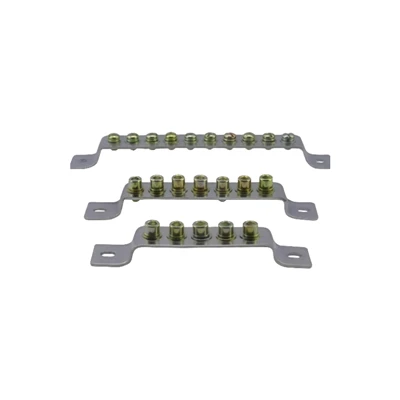
The neutral busbar 2x25 5pole is a 50 mm² distribution bar that gives five circuits one common neutral or protective earth point inside a control cabinet. Each of the five poles takes two conductors up to 25 mm², so ten outgoing cores land on a single bar instead of being stacked along a terminal rail.
What decides whether a bar like this still performs after a few years is its surface. Untreated copper and brass react with the humidity and sulfides present in most cabinets: the face dulls, then darkens, and the film that forms conducts poorly. Contact resistance climbs, the joint runs warmer at the same load, and the cabinet builder hears about it from the end user. Electrolytic tin plating at 3–5 µm seals the bar against that reaction before it ever leaves the packing line.
The bar arrives ready to mount. Pole pitch is held at the standard 18 mm or 25 mm module spacing, the end holes take standard DIN rail brackets, and the conductor follows your panel specification - tin-plated brass CuZn37 or high-purity copper C11000. Pole counts from 3 to 12 and alternative hole patterns are produced to drawing, so the same part number family covers a whole cabinet range.
Technical Specifications
Values below are the standard configuration. Confirm each line against your panel drawing or BOM before release: the continuous current in particular is set by the bar cross-section and by how the bar is mounted and ventilated.
| Parameter | Value |
|---|---|
| Busbar Cross-Section | 2 mm × 25 mm (50 mm² effective) |
| Number of Poles | 5 |
| Conductor Entries Per Pole | 2 |
| Conductor Range | Up to 25 mm² per entry |
| Conductor Material | Tin-plated brass (CuZn37) or high-purity copper (C11000) |
| Surface Finish | Electrolytic tin plating, 3–5 µm standard (5–8 µm option) |
| Conductivity | ≥ 56 MS/m (brass) / ≥ 58 MS/m (copper) |
| Anti-Oxidation | Tin plating provides long-term corrosion resistance in humid environments |
| Continuous Current Rating | Set by bar cross-section and mounting - this series publishes 200 A for the 75 mm² bar and 300 A for the 90 mm² bar in free air; the 50 mm² value is confirmed on request |
| Screw Specification | M4 / M5 (depending on pole configuration) |
| Hole Diameter | 4.2 mm (M4) / 5.2 mm (M5) |
| Recommended Torque | 2.5–3.5 N·m for the M5 screw (series figure); M4 value confirmed on request |
| Pole Center Distance | Standard 18 mm or 25 mm pitch (specify when ordering) |
| Mounting | Compatible with standard DIN rail brackets |
| Service Environment | Indoor and outdoor distribution panels; humid and coastal locations supported by the heavy-duty plating option |
| Customization | OEM / ODM supported per customer drawings |
| MOQ | Depends on configuration; trial orders negotiable |
| Quality Guarantee | 12–24 months from shipment date |
| Manufacturing Standard | ISO 9001 quality management system |
| Packaging | Standard export packaging; cartons of 50 or 100 pieces for the standard bar |
| Delivery Ports | Ningbo Port / Shanghai Port |
| Quote Turnaround | Within 24 hours |
Core Advantages
Four design decisions do most of the work on a bar that has to sit in a humid cabinet for a decade.
Tin Plating Instead Of Bare Copper
Electrolytic tin plating at 3–5 µm covers the bar surface, the edges and the contact faces. Copper and brass no longer meet the humidity and sulfides in the cabinet air, so the dull-to-black oxidation cycle that raises contact resistance never starts. The bar is still conductive - and still bright - at the end of its service life.
01
Two 25 mm² Entries On Every Pole
Each of the five poles accepts two conductors up to 25 mm². Feed-in and feed-out can share a pole, so a run can be looped without doubling the pole count. Ten terminations on one bar is what makes this format compact enough for small enclosures.
02
A 50 mm² Cross-Section On A 2 mm Profile
A 2 mm × 25 mm bar carries the summed neutral current of the circuits it serves with more copper in the section than a thin stamped profile has. It mounts flat against the back plate and stays stable on the standard 18 mm or 25 mm pitch.
03
Uniform Pitch, Uniform Clamp Pressure
Every pole carries its own clamping screw, so torque is set pole by pole rather than shared along a single rail. Spring lock washers resist loosening under vibration, and brass screws are available where galvanic corrosion between dissimilar metals is the larger risk.
04
Wire Cage Terminal vs Traditional Brass Terminal
This heading is kept so the section matches the rest of the site. On this product the termination is a screw clamp on a tin-plated bar, never a wire cage, so the comparison below is written around that interface.
| Point Of Comparison | Tin-Plated Screw-Clamp Busbar (This Product) | Traditional Bare Brass Bar |
|---|---|---|
| Conductor interface | Screw clamp bearing on a flat, tin-plated face | Bare screw seating on an oxidised bar surface |
| Entries per pole | Two conductors up to 25 mm² each | Usually one conductor per pole |
| Surface in a humid cabinet | Tin plating keeps the face bright and conductive | Copper and brass darken; the film blocks the joint |
| Contact resistance over service life | Stable, no periodic cleaning routine | Creeps up as the oxide layer grows |
| Cross-section and load | 2 mm × 25 mm machined bar, 50 mm² effective | Depends on the supplier; thin profiles heat up sooner |
| Assembly | Five poles on one bar at fixed 18 mm or 25 mm pitch | Discrete terminals wired pole by pole |
| Ordering | Standard 5-pole, plus OEM pole counts 3P–12P and hole patterns to drawing | Fixed configurations only |
Professional Production Process
Five steps, with the plating and the hole positions checked on every batch.
Bar cutting and forming - copper or brass bar is cut to length and formed to the customer drawing.
Punching and drilling - pole holes, terminal holes and end mounting holes are positioned to the drawing within its stated tolerance.
Electrolytic tin plating - the formed bar is plated to 3–5 µm standard, or 5–8 µm where a heavier coating is specified.
Screw assembly - M4 or M5 screws are fitted pole by pole, each with an integrated spring lock washer.
Inspection - plating thickness, hole position, thread condition and a torque check on the assembled poles are recorded per batch.
Material & Surface Treatment Options
Two material decisions carry most of the cost, so they are worth settling before the order is placed.
Conductor Material: Brass CuZn37 Or Copper C11000
Tin-plated brass CuZn37 reaches ≥ 56 MS/m and is the usual choice for cabinet builders working to a budget. High-purity copper C11000 reaches ≥ 58 MS/m and holds a marginally lower resistance over the same cross-section. Both come with the same electrolytic tin finish, and both are available at 50 mm² in this 5-pole format.
Tin Plating Thickness: 3–5 µm Or 5–8 µm
Standard plating is 3–5 µm, which covers indoor distribution boards, control cabinets and ordinary panel interiors. Where the cabinet sits in a coastal plant, a tunnel or any atmosphere carrying sulfide or salt, the 5–8 µm option is specified; the difference is how long the coating lasts before the base metal is exposed.
Screw Material: Galvanised Steel Or Brass
Galvanised steel screws are the standard supply and give the highest clamping force. Brass screws are non-magnetic and match the bar metallurgically, which removes the dissimilar-metal couple behind galvanic corrosion in humid and coastal installations. Both are supplied with integrated spring lock washers.
Application Scenarios
Four cabinet types where a compact 5-pole neutral bar does the work of a row of discrete terminals.
Control Cabinets And Distribution Boards
Machine and process control cabinets where the neutrals of several single-phase loads have to be collected without widening the terminal rail. Five poles at standard module pitch sit alongside breakers and contactors in enclosures that have little spare depth.
Lighting And Small Circuit Distribution Panels
Lighting panels and sub-boards feeding a handful of outgoing ways, where each way returns on the same dedicated bar instead of sharing a breaker terminal. One bar replaces the individual neutral terminals the schedule would otherwise call for.
MCCB And RCD Distribution Panels
Panels built around MCCBs and RCDs, where neutral has to stay separated from earth and return to a single point. The same bar is supplied in brass or copper for the protective earth role, so a cabinet can use one part number for both duties.
Photovoltaic AC Combiner Boxes
AC combiner boxes on PV arrays, where the inverter output neutral returns through an enclosure that sees wide temperature swings and, on coastal sites, a salt-laden atmosphere. The heavy-duty plating option is specified for those locations.
Frequently Asked Questions
Q: What is the difference between this bar and a plain copper busbar?
A: The bar is the same idea - one conductor shared by several circuits. The difference is the surface. Electrolytic tin plating at 3–5 µm prevents the oxidation that dulls bare copper and brass in humid cabinets and pushes contact resistance upward over time.
Q: How much current can the 2×25 5-pole bar carry?
A: Continuous current depends on the bar cross-section and on how the bar is mounted. This series publishes 200 A for the 75 mm² bar and 300 A for the 90 mm² bar in free air; the figure for this 50 mm² bar is confirmed on request against your load schedule.
Q: Which conductors fit, and how many per pole?
A: Each of the five poles takes two copper conductors up to 25 mm² - ten terminations on one bar. Hole diameter follows the screw size, 4.2 mm for M4 and 5.2 mm for M5, and pole pitch is 18 mm or 25 mm, specified at order.
Q: Can you produce other pole counts or hole patterns?
A: Yes. Standard supply is the 5-pole bar in cartons of 50 or 100 pieces. Pole counts of 3P, 4P, 6P, 8P, 10P and 12P, alternative hole patterns and non-standard lengths are produced to your drawing under OEM terms; MOQ depends on the configuration and any tooling.
Q: What about testing, packaging and delivery?
A: Plating thickness, hole position and torque are checked per batch. Units ship in standard export packaging from Ningbo or Shanghai ports, with a 12–24 month quality guarantee from shipment date. Send your drawing and quantity for a quote within 24 hours.
Hot Tags: neutral busbar 2x25 5pole, China neutral busbar 2x25 5pole manufacturers, suppliers, factory, Ground Busbar 3x25 12Pole, Neutral Busbar 2x25 5Pole, neutral busbars, Neutral Terminal 250A 16 To 50sqmm, Neutral Terminal 600A 35 To 95sqmm, Standalone Neutral Terminal 100A 10 To 35sqmm