







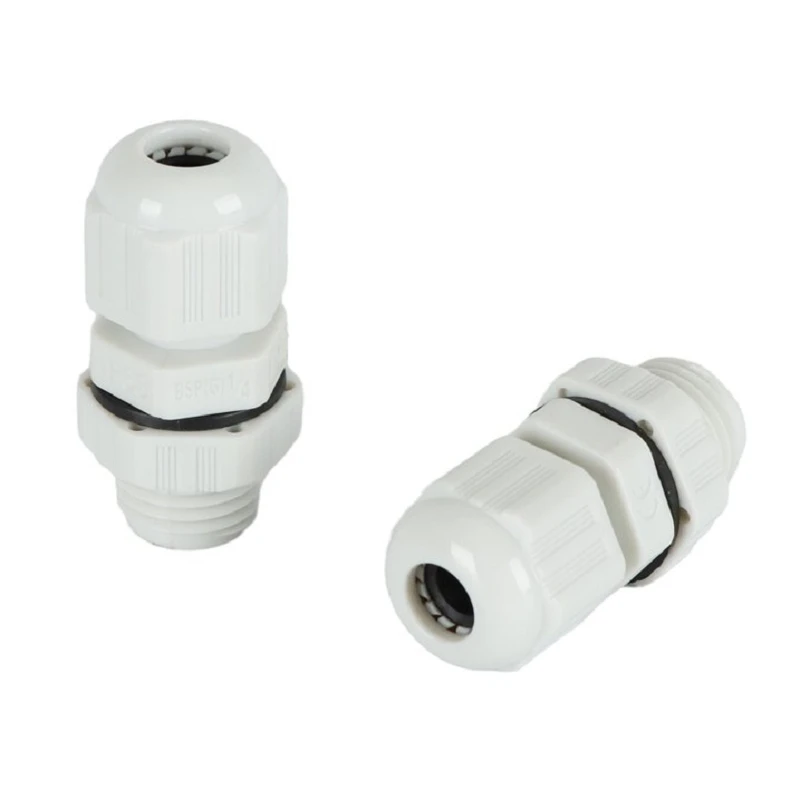
Product Overview

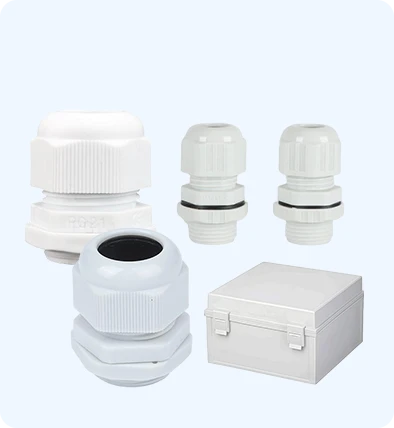
Open almost any control cabinet and the small entries along the gland plate are M20. It is the size instrumentation, sensor and control wiring has settled on: a 6 mm to 12 mm jacket passing through a threaded body that seals the wall and holds the cable. The nylon cable gland metric m20 is built for that job, on control boxes and on machinery.
Two dimensions sitting close together cause a large share of the trouble at this size. A PG13.5 tapping and an M20 body differ by 0.4 mm across the thread and by nothing at all in appearance, so a fitter can start one into the other and feel the bind only near the end of the travel. Driving it home from there cracks the enclosure boss; leaving it part-seated means the ring never loads.
The other recurring failure is the sealing ring, which either tears under the clamping nut or sets flat after a season outdoors and stops pressing on the jacket. Both outcomes leave a gland that looks installed and does not seal. The answer here is a ring loaded radially and evenly, held by a PA66 body with its UV package built into the resin, working from -40 °C to +100 °C.
Technical Specifications
Values below are the standard configuration. One check matters before ordering: confirm the enclosure thread standard, not the hole size. Metric and PG bodies are not interchangeable even though the outside diameters look close, and the difference only shows on the last turn - the exact point where installations jam.
| Parameter | Specification |
|---|---|
| Thread | M20 × 1.5, ISO metric profile |
| Outer Diameter / Pitch | 20 mm / 1.5 mm |
| Mates With | Metric M20 tapped entries only - not PG13.5 |
| Jacket Range | 6 mm – 12 mm |
| Sealing | IP68 with the cable correctly installed (series reference to IEC 60529) |
| Body | PA66 polyamide, UV-stabilized |
| Sealing Ring | EPDM as standard; oil-resistant neoprene on request |
| Working Temperature | -40 °C to +100 °C |
| Flame Class | UL94-V2 standard; UL94-V0 on request |
| Panel Cut-Out And Spanner Size | To be confirmed for M20 (series publishes 32.5 mm cut-out and 36 mm spanner for the M32 body) |
| Thread Length And Panel Thickness | To be confirmed for M20 (series publishes 15 mm standard and 20 mm long thread; 1–6 mm and 1–12 mm panel) |
| Fitting | Hand-tight to first ring compression, then a quarter turn with a spanner |
| Bespoke Builds | OEM / ODM to drawing - thread, seal compound, packaging |
| Minimum Order | Set by the configuration; trial quantities accepted |
| Guarantee | 12 to 24 months, counted from the shipment date |
| Plant Standard | ISO 9001 quality management system |
| Packing | Export cartons, or poly bags and labels under your own brand |
| Shipping | Ningbo and Shanghai |
| Quotation | Returned inside 24 hours |
Core Advantages
Four points decide whether a small entry is still sealing in year five.
The Thread Bites On The Last Turn, Not Before
Cutting to the ISO metric profile, and gauging samples drawn from every batch, is what keeps a body running smoothly to full seat. A form off by a few hundredths of a millimetre feels fine for most of the travel and binds at the very end, which is where a fitter leans on the spanner and damages the enclosure.
Ring Load Spread Around The Circumference, Not Pinched At One Edge
The nut drives the ring inward onto the jacket, so pressure is distributed all the way round. A ring pinched at a single point is the one that tears, and the symptom is an entry that weeps weeks after commissioning. A round jacket and a deburred cut-out are the only preparation the ring asks for.
UV Package Compounded Into The Resin
Stabilizer added to the PA66 compound cannot flake off the way a surface treatment can, so the body keeps its strength through years of daylight on a pole or a south-facing wall. Plain polyamide chalks first and then cracks at the thread root, which is where the joint starts to leak.
Strain Relief Without A Separate Clamp
Because the ring grips the jacket, a tug on the cable is taken by the seal instead of by the terminals and busbar inside the box. Compact enclosures rarely have room for a clamp at every entry, so this is one fitting and one operation saved per cable.
Wire Cage Terminal vs Traditional Brass Terminal
The heading comes from the site template and is kept as published. A gland has no wire cage, so the choice a buyer actually makes at this size is between thread families - the metric thread below against the PG thread it is so often mistaken for. Both columns use the figures published on the source page.
| Point Of Comparison | Metric M20 × 1.5 (This Product) | PG13.5 |
|---|---|---|
| Standard behind the thread | ISO metric | German Panzergewinde |
| Thread outside diameter | 20 mm | 20.4 mm |
| Pitch | 1.5 mm | 1.814 mm |
| Where each is usual | The global and EU standard position | Germany and older European equipment |
| Jacket range offered | 6–12 mm | 6–12 mm |
| Will one replace the other? | No. The outside diameters look close and the pitches differ, so read the thread standard off the enclosure before ordering. |
Professional Production Process
Four operations carry the quality of the part, and the thread and the ring seat are checked on every batch.
Moulding - body, nut and insert come off the tool in UV-stabilized PA66 to the M20 × 1.5 profile.
Ring production - sealing rings are moulded to the 6–12 mm band; alternative compounds run on the same tooling for special orders.
Thread and seat check - gauge and seating checks are run on samples from each batch, and the readings are recorded.
Assembly and packing - parts are assembled, the thread is run through its travel to clear flash, and the count is packed to export cartons or to your own bag and label.
Material & Surface Treatment Options
Three specifications carry nearly all of the cost, so they are best settled before the order goes in.
Body Resin: PA66 With The UV Package Compounded In
The housing is polyamide 66 with stabilizer in the compound, which is what makes an unsheltered outdoor position viable. The same resin carries the flame class, and because it does not conduct there is no earth tag to fit at the entry.
Sealing Ring: EPDM As Standard, Neoprene Where Oil Is Present
EPDM is the standard ring and covers -40 °C to +100 °C, which is right for an ordinary cabinet. Continuous oil or cutting-fluid exposure is a different requirement: EPDM swells and loses preload in oil, so a neoprene ring can be supplied on request for machine-side positions.
Flame Class: UL94-V2 Standard, UL94-V0 Where The Panel Demands It
V-2 satisfies most enclosure specifications. V-0 is specified where the panel itself is held to V-0, or where the enclosure stands in a public location. Class is a property of the moulded resin, so it belongs on the order rather than in an assumption.
Application Scenarios
Four positions where this size does the work.
Control Cabinets And Distribution Boards
Contactor cabinets and small distribution boards wired in 0.75–1.5 mm² flexible cord, where a row of M20 entries takes the outgoing circuits. The insulating body and short footprint let several entries sit close together on the gland plate.
Machine-Side Junction Boxes
Junction boxes on machine frames, taking sensor, valve and actuator leads into the cabinet. Each jacket is gripped for strain relief, and where oil mist is in the air the neoprene ring is the compound to write on the order.
Street Lighting And LED Driver Housings
Driver input and output cables entering a luminaire or pole-top housing. The stabilized resin is what lets one gland stay on a pole for years instead of chalking out after a couple of summers.
Sensor, Telemetry And IoT Enclosures
Environmental monitoring and remote telemetry boxes that need a small watertight entry for a signal cable. The 6–12 mm band covers the instrumentation and fieldbus jacket sizes these housings are wired with.
Frequently Asked Questions
Q: What jacket sizes fit this gland?
A: Between 6 mm and 12 mm across the outer jacket, which covers instrumentation cable, sensor leads and small flexible cord. Measure the jacket rather than the conductor, because the ring seals on the outside of the cable.
Q: Will an M20 body fit a PG13.5 tapping?
A: It will start, and that is the trap. The pitch differs, 1.5 mm against 1.814 mm, so the body binds before it seats. Read the thread standard off the enclosure drawing and order to that, not to the hole diameter.
Q: How tight should the nut be?
A: Until the ring is visibly compressed onto the jacket, then a quarter turn with a spanner. Anything past that pinches the ring out of shape, and the watertight performance goes with it.
Q: Is the standard ring suitable near machinery with oil mist?
A: Not for continuous oil contact, where EPDM is the wrong compound. An oil-resistant neoprene ring can be supplied on request and should be named on the order for machine-side positions.
Q: Do you make other thread sizes, and how quickly is a price returned?
A: The range runs M12 to M32 metric and PG11 to PG21, each available under your own brand and packaging. Minimum order depends on the build. Send the thread standard, jacket diameter and quantity, and a quotation is returned within 24 hours.


Hot Tags: nylon cable gland metric m20, China nylon cable gland metric m20 manufacturers, suppliers, factory, cable glands, Nylon Cable Gland Metric M12, Nylon Cable Gland Metric M20, Nylon Cable Gland Metric M32, Nylon Cable Gland PG11, waterproof enclosures


